
Why Do you Need to Change Your AC Filter So Often?
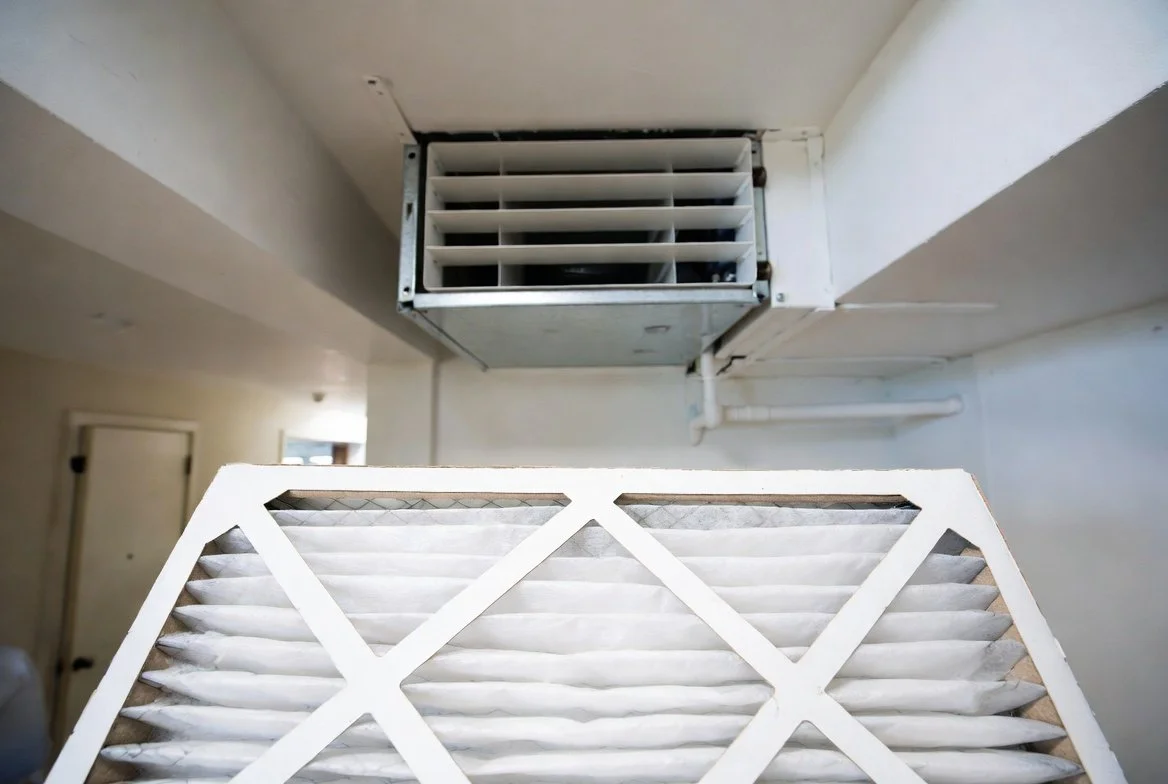
We’ve all been told that we should change our AC filters every month. Some people even recommend doing it every time you get your electric bill, so you have a good way to remind yourself.
But when you pull the filter out, you look at it and it’s still kind of white and clean. Not much dirt, but you change it out anyways. Because that’s what you’re told. But what if I told you those clean-ish air filters you’re tossing away actually work better than a brand new one and that changing it out at the right time could save you money?
Down and Dirty: How Air Conditioners Work
Your air conditioner has two parts, the air handler, which is inside the house somewhere like a closet, utility room, or the attic, and a condenser, which is outside. Warm air is pulled into the system from the return vents in your house. Sometimes your return vent will have a filter, sometimes the filter is in the air handler, it depends on the system. As the air is pulled into the air handler, it passes through this filter, removing any dust or debris that could accumulate inside the system.
Inside your air handler or furnace is the evaporator coil. A refrigerant flowing through this coil is extremely cold. As the warm air passes over it, heat moves from the air into the refrigerant. At the same time, moisture in the air condenses on the cold coil, which is why your AC also dehumidifies your home. Once the heat has been removed, the blower pushes the cooler air through your supply ducts and out the vents. The refrigerant, now warm from absorbing heat indoors, travels through insulated copper lines to the outdoor unit.
When it gets to the outdoor condenser, the compressor squeezes the refrigerant, raising its pressure and temperature. The outdoor fan blows outside air across the condenser coil, allowing the refrigerant to release the heat it collected from your house. After giving up its heat, the refrigerant passes through an expansion device that drops its pressure and temperature before it returns to the indoor coil to absorb more heat.
Why Does the Filter Matter?
The filters remove debris before it can accumulate in the interior of the air handler or in your ducts. Using a quality filter can help to reduce the amount of dust and debris that is in your system. This keeps your system cleaner, and honestly, your house stays a little less dusty too because the dust is not being recirculated.
The air going into the air handler is pushed through the filter. This means that any dust in the air in your house is caught in the filter. When the dust begins to accumulate on a new filter, the dust becomes electrically charged through a process called triboelectric charging, which is the same phenomenon that causes static electricity when you rub a balloon on your hair or shuffle across a carpet.
As air is pushed through the filter, tiny particles of dust, pollen, pet dander, fabric fibers, and smoke constantly bump into each other and the filter fibers. Every bump can transfer a few electrons from one material to another, causing some to end up with a slight positive charge, while others become slightly negative. The filter fibers themselves can also develop small static charges from this constant airflow and friction.
These charges are extremely weak, but they're enough to matter because dust particles are so tiny and light.
So once the first little layer of dust sticks to the filter, it creates a much more complex surface with thousands of tiny fibers and particles sticking out in different directions. As new dust passes by, several things increase the chances that it will be captured:
• Some particles are attracted by weak electrostatic forces.
• Other particles physically bump into the trapped dust and stick.
• The thicker dust layer creates smaller pathways for air, making it more likely that particles collide with something instead of slipping straight through.
This is why a slightly loaded filter can actually remove some smaller particles more efficiently than a brand-new filter. Engineers sometimes refer to this as the filter "conditioning" or developing a "dust cake." The accumulated particles become part of the filter itself.

What Does an Overloaded Filter Look Like?
An overloaded filter typically is a medium to dark grey. This color can change depending on the dust and pollen in your area. In seasons when pollen is extremely high, your overloaded filter might have a slight yellow tint to it.
When Should I Change my Filter?
That answer truly depends on you and your household. If you have a household with children and pets, you might find more dust is in the house and you truly do need to change your filter every month because it’s overloaded. Sometimes, if you have more pets and pet hair than dust, you can vacuum off your filter and it’s still only lightly loaded without all the animal fur and still good.
When we lived in Florida, we had 3 dogs and 2 cats. I would vacuum the filter off because underneath all the animal hair was a like-new filter. Our filters would typically last about 3 months.
In the summer months, our filters usually needed to be changed more often. This was not only because we were running the system more, but because the humidity inside and outside would affect the structural quality (aka the cardboard) on the filter and cause it to bend. The humidity also affected the dust on the filter, making it wetter, and heavier and the filter would become overloaded sooner. The bending would occur when the air could no longer easily push through the filter and the filter would bend to accommodate the air flow. Bending provides gaps for unfiltered air to pass into the air handler without being filtered.
What Type of Filter Should I Buy?
Now this is fun, and confusing all at the same time. When you walk down the aisle in the hardware store or the grocery store, there’s a ton of filters to choose from. Most of the selection is based on size. Some filters are made for return vents and others are made to go inside the air handler itself. Each has a different size, like floor tiles.
But the type is where you should pay attention.
You have 4 types of filters that you can buy and each of these 4 will have a rating, called a Minimum Efficiency Report Value, or MERV for short.
MERV Ratings
MERV stands for Minimum Efficiency Reporting Value. It's a standardized rating developed by the American Society of Heating, Refrigerating and Air-Conditioning Engineers that measures how well an air filter captures particles of different sizes.
The rating ranges from 1 to 16 for most residential and commercial HVAC filters. (Ratings above 16 are generally HEPA or specialty filters used in hospitals, laboratories, and clean rooms.)
As the MERV number increases, the filter captures smaller particles.
|
MERV Rating |
Captures |
Typical Use |
|---|---|---|
|
1-4 |
Large dust, lint, carpet fibers |
Basic fiberglass filters |
|
5-8 |
Mold spores, pollen, pet dander |
Standard residential homes |
|
9-12 |
Fine dust, cement dust, some smoke |
Homes with allergies or pets |
|
13-16 |
Many bacteria, smoke, very fine particles |
Hospitals, medical offices, premium residential systems designed for them |
During COVID, HEPA and high MERV rated filters were highly sought after because they were better at capturing smaller particles, like the COVID virus.
But here’s the catch... If you put a really thick filter into your system, you end up restricting air flow, making the unit work harder. This not only increases your electric bill, but it creates extra wear and tear on your system and reduces the lifespan of the system.
Which MERV Rating Is Right For You?
Most houses and apartments use standard air handling systems which use similar air flow calculations and have comparably sized motors and blowers for the size of the space.
Imagine trying to breathe through different materials. Breathing through a window screen is easy. Breathing through a thick winter scarf takes much more effort. Air filters work the same way. As the filter catches smaller particles, it also becomes harder for air to pass through. The goal isn't to stop all the dust, it's to find the balance between clean air and good airflow.
For most homes:
• MERV 1–4: Usually too little filtration for today's expectations.
• MERV 6–8: A good balance of airflow, equipment protection, and household dust control.
• MERV 8–11: Often the best choice for homes with pets or mild allergies, assuming the HVAC system can handle it.
• MERV 13: Good for reducing fine particles and smoke, but only if the manufacturer recommends it or the system is designed for the additional airflow restriction.
Always check your HVAC manufacturer's recommendations before moving to a significantly higher MERV rating.
Type of Filters
Fiberglass Filters
These are the really cheap blue or white filters, which are made to protect the A/C system, not improve the indoor air quality. They catch larger particles of dust, hair, carpet fibers and lint. These create very low airflow restriction, but they don’t really help keep dust and allergens out of the air.
Pleated Filters
This is the most common type of filter you can find today. Most filters are this white, fabric-ish pleated material, which increases the surface area that can catch dust. More surface area means more dust and debris collection. Pleated filters typically don’t cause too much restriction and are a good choice to use in almost all units. They can typically be found with the MERV ratings between 6-13. More on MERV down below.
Electrostatic Filters
These are made with materials that create an electrostatic charge as air moves through them. This is an occurrence that happens in all filters, but these filters use certain synthetic fibers that increase the chance of the charge developing. Electrostatic filters come in two types: disposable, which you toss out, and Washable, which you rinse off and put back in the unit. The washable ones may save money, but they don’t typically work as well as the disposable ones and they do wear out over time.
HEPA Filters
HEPA filters have become very popular as more awareness of indoor air quality is put out in the open. They’re able to remove 99.97% of particles that are 0.3 microns in diameter, which is incredibly small. To put it in perspective, a human hair is about 250 times wider than a 0.3-micron particle. A grain of table salt is roughly 200–300 times larger. Most pollen grains are around 100 times larger. And many mold spores are 10–30 times larger. The filters that I show below are HEPA filters, but they have high MERV ratings, which means that they may not be the best choice for your system and may cause air flow problems.
A good visual analogy is this:
If a human hair were as wide as a two-lane road (about 24 feet), then a 0.3-micron particle would be about the size of a golf ball sitting on that road.
In order to filter particles that small, the filter has to be really tightly woven with very little space between the filter fibers. This means that air does not move through it very easily. It would require a lot of oomph from the air handler to pull air through that much restriction. Most household air handler don’t have this oomph.
Typically, its hospitals, doctor offices, or really fancy air conditioning systems that use these because they are made specifically for these filters. If you were to use one in your home, you could inadvertently hurt your system.
Conclusion
To bring this full circle, you should check your filter monthly and determine if it needs to be changed. Change the filter when it begins to restrict airflow—not simply because the calendar says it's time. But don’t worry about replacing a clean or barely dirty filter because it will actually work better. When it comes to buying air filters, the best air filter isn’t the one that catches the most dust, but it’s the one that catches enough dust while still allowing your air handler to move the amount of air it was designed to deliver.