
Chamomile: More Than Just a Bedtime Tea
Most people know chamomile as the tea you drink before bed. It's the little yellow-and-white flower that's supposed to help you relax after a stressful day.
But chamomile is much more than a sleep herb.
Herbalists have used chamomile for centuries to calm an upset stomach, ease digestive cramps, soothe irritated skin, relieve tension headaches, and help people unwind when stress starts showing up in the body. In fact, many herbalists would argue that chamomile's greatest strength isn't helping you sleep—it's helping your body let go of tension.
Once you understand how chamomile works, you can see why one small flower can help so many different problems.
Meet the Plant
When people talk about medicinal chamomile, they're usually referring to German chamomile (Matricaria chamomilla). This is the variety most commonly grown for tea and herbal remedies.
German chamomile is an annual plant that readily self-seeds in the garden. Once established, it often returns year after year with very little effort. The flowers resemble tiny daisies, with bright yellow centers surrounded by white petals.
Roman chamomile (Chamaemelum nobile) is another medicinal species. It shares many of the same properties but grows as a low perennial groundcover rather than a taller annual.
Both belong to the daisy family, making them relatives of calendula, echinacea, yarrow, and dandelion.
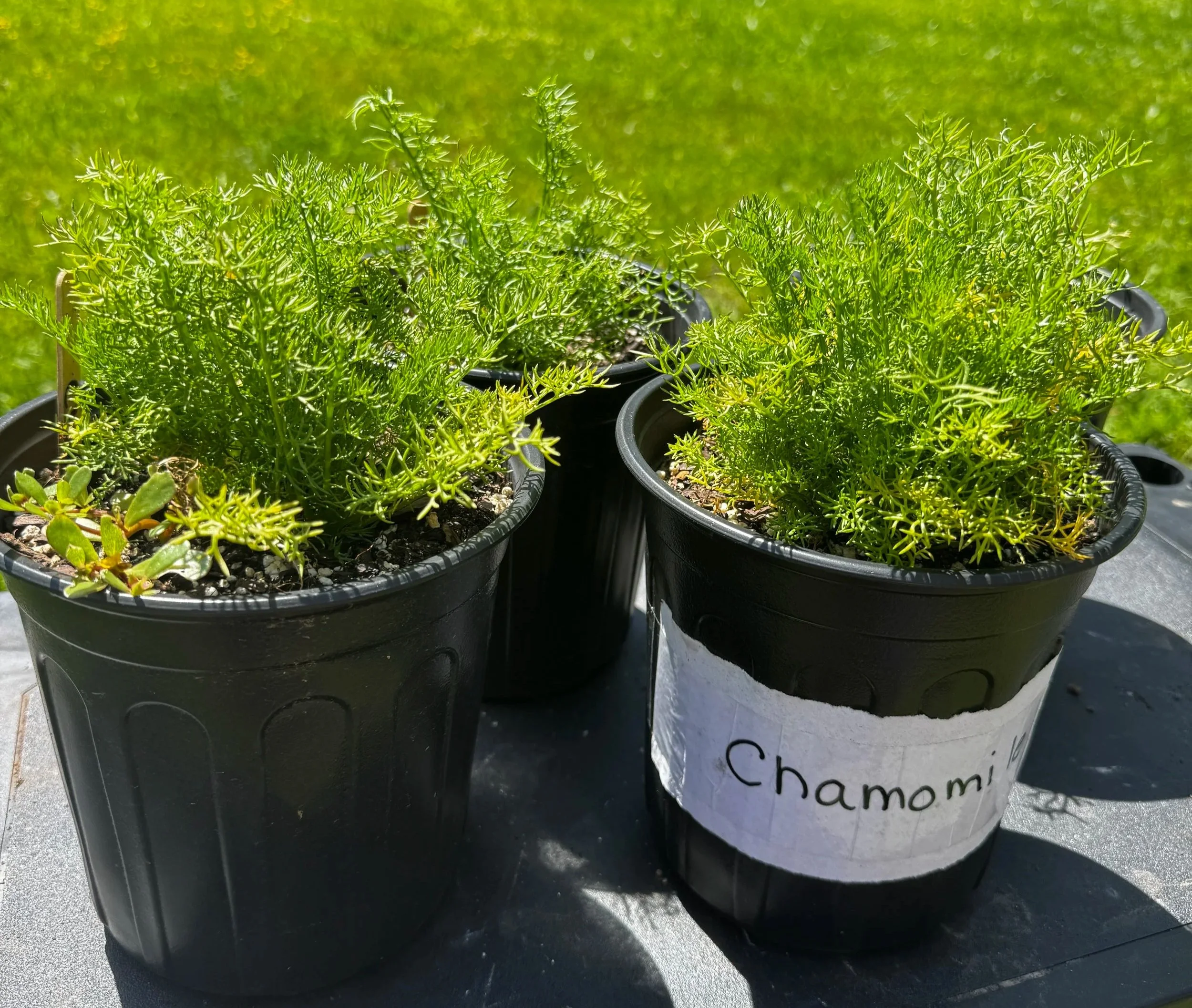
Want More Chamomile?
You can find everything you need to know about growing Chamomile, teas, and herbal remedies all right here.
Why Herbalists Love Chamomile
Chamomile is one of those herbs that seems to show up everywhere.
Can't sleep? Try chamomile.
Upset stomach? Chamomile.
Stress headache? Chamomile.
Child with a tummy ache? Chamomile.
At first glance that sounds almost too good to be true, but there’s actually a reason for it. Many health complaints don't happen by themselves. Think about what happens during a stressful week.
Your shoulders tighten. Your stomach feels off. You might get headaches. You sleep poorly. Your digestion slows down or becomes uncomfortable.
These symptoms seem unrelated, but they're all connected through your nervous system.
Chamomile works particularly well because it doesn't just target one symptom. It helps calm several stress-related pathways all at once.
What Makes Chamomile Work?
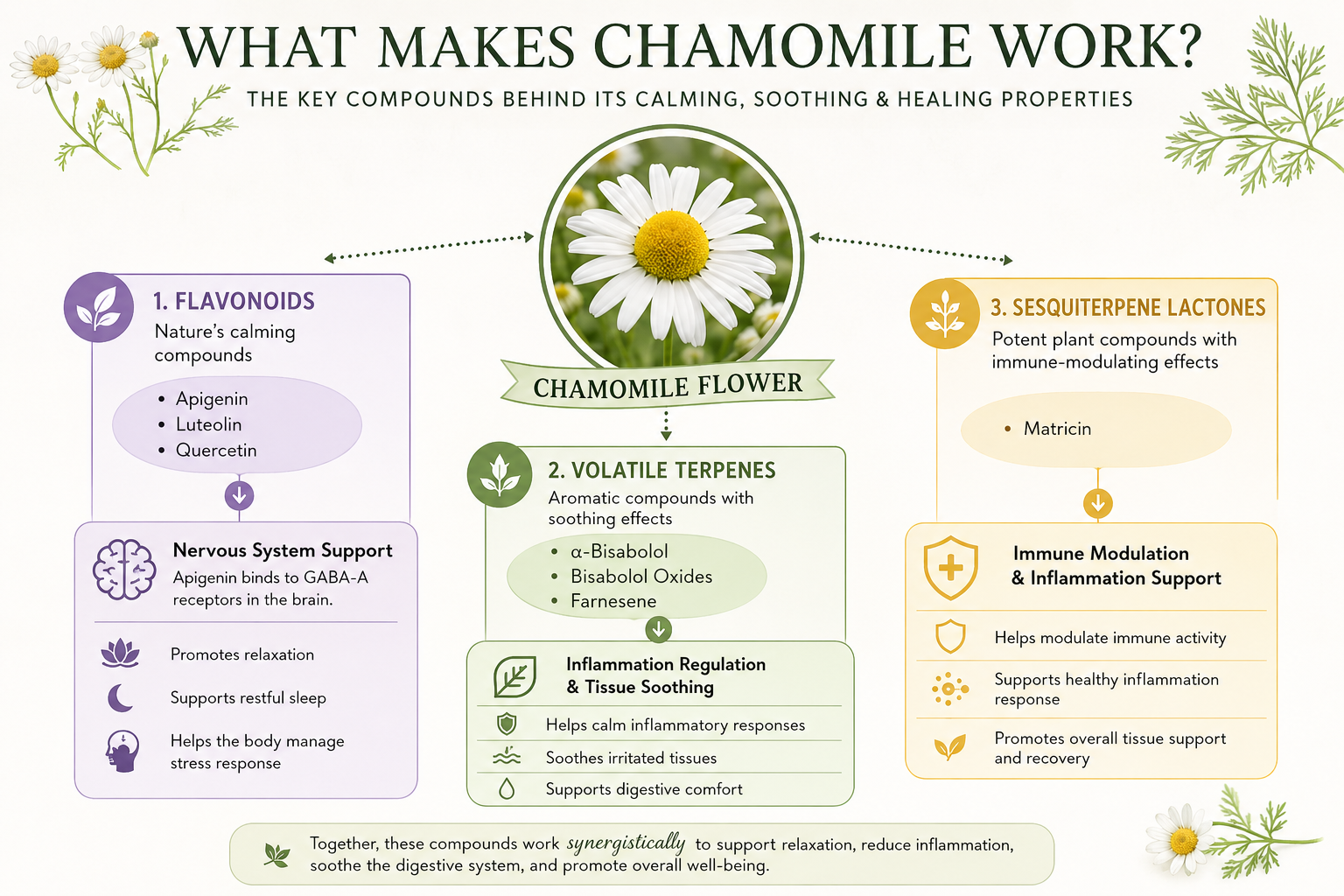
Inside every chamomile flower are hundreds of plant compounds. Scientists have identified many of them, but a few stand out as particularly important.
The two groups you'll hear herbalists talk about most are the essential oils (terpenes) and the flavonoids.
Don't let the names scare you off. They're simply different families of plant chemicals.
The Terpenes
When you crush a chamomile flower and smell that sweet, apple-like fragrance, you're smelling the plant's terpenes, which are commonly referred to as essential oils once they’ve been extracted.
These aromatic compounds help protect the plant from insects and disease, but they also have powerful effects in our bodies.
Some of the most important are called bisabolol and chamazulene.
Bisabolol has been studied for its ability to calm inflammation and support tissue healing. This is one reason chamomile is commonly used in skin creams, salves, and lotions designed for sensitive or irritated skin.
Chamazulene is particularly fascinating because it isn't actually present in fresh chamomile flowers. It forms during drying and processing from another compound called matricin.
If you've ever seen true chamomile essential oil, you've probably noticed its deep blue color, which is caused by Chamazulene.
Researchers believe these two compounds contribute to many of chamomile's traditional uses for irritated skin, inflamed digestive tissues, and minor wounds. Kerry Bone discusses chamomile's anti-inflammatory properties as being closely tied to these volatile oil constituents.
The Flavonoids
If the essential oils are chamomile's fragrance, the flavonoids are much of its nervous system support.
The most famous flavonoid in chamomile is called apigenin.
Apigenin has attracted a lot of research because it appears to interact with GABA receptors in the brain. GABA is one of your body's main calming neurotransmitters. Its job is to help quiet nervous system activity when things become overstimulated.
You don't need to memorize any of that to understand the takeaway:
Apigenin appears to help the brain shift toward a calmer state.
This helps explain why chamomile can take the edge off stress without making most people feel heavily sedated.
Other flavonoids in chamomile, including luteolin and quercetin, also provide antioxidant and anti-inflammatory effects. These compounds help protect cells from damage and may contribute to chamomile's long history of use in inflammatory conditions. Flavonoids are considered one of the major therapeutic compound groups in medicinal plants because of their wide-ranging effects throughout the body.

Why Chamomile Helps the Stomach
This is the part that surprised me when I first started studying herbalism. Most people think chamomile works because it's relaxing. While that's true, it also directly affects the digestive system.
Chamomile acts as an antispasmodic, which means it helps relax involuntary muscle contractions.
Your digestive tract is lined with smooth muscle that constantly contracts and relaxes to move food through the body. When those muscles become tense or irritated, you may experience:
Cramping
Bloating
Gas
Digestive discomfort
Chamomile helps those muscles relax.
At the same time, its anti-inflammatory compounds help soothe irritated digestive tissues. This combination is one reason chamomile has been used for generations for nervous stomachs, indigestion, and digestive cramps.
What Modern Research Says
One of the things I appreciate most about chamomile is that modern research often confirms what traditional herbalists have been saying for hundreds of years.
Studies have investigated chamomile for:
Anxiety
Mild insomnia
Digestive complaints
Skin inflammation
Wound healing
The strongest evidence appears to support its role in mild anxiety and stress-related symptoms. Which is exactly how many traditional herbalists use it.
Chamomile isn't usually the strongest herb in the apothecary. Instead, it's one of the gentlest and most reliable. And sometimes that's exactly what's needed.
My Favorite Thing About Chamomile
The more I learn about herbs, the more I realize that the best plants rarely do just one thing. Chamomile doesn't simply help you sleep.
It helps relax a tense body. It soothes an irritated stomach. It calms inflammation. It eases nervous tension.
In other words, it supports the whole person rather than chasing a single symptom.
Maybe that's why this tiny daisy-like flower has remained one of the world's most beloved medicinal herbs for thousands of years.